Preparing a Vessel of Grace
On the Five Phases, the Great Feasts, and the Nativity of the Theotokos
This post may primarily be of interest to Orthodox readers but is also relevant to anyone interested in either the concept of liturgical cycles or the Five Phases of Traditional Chinese Medicine (see my previous post for an intro to that concept).
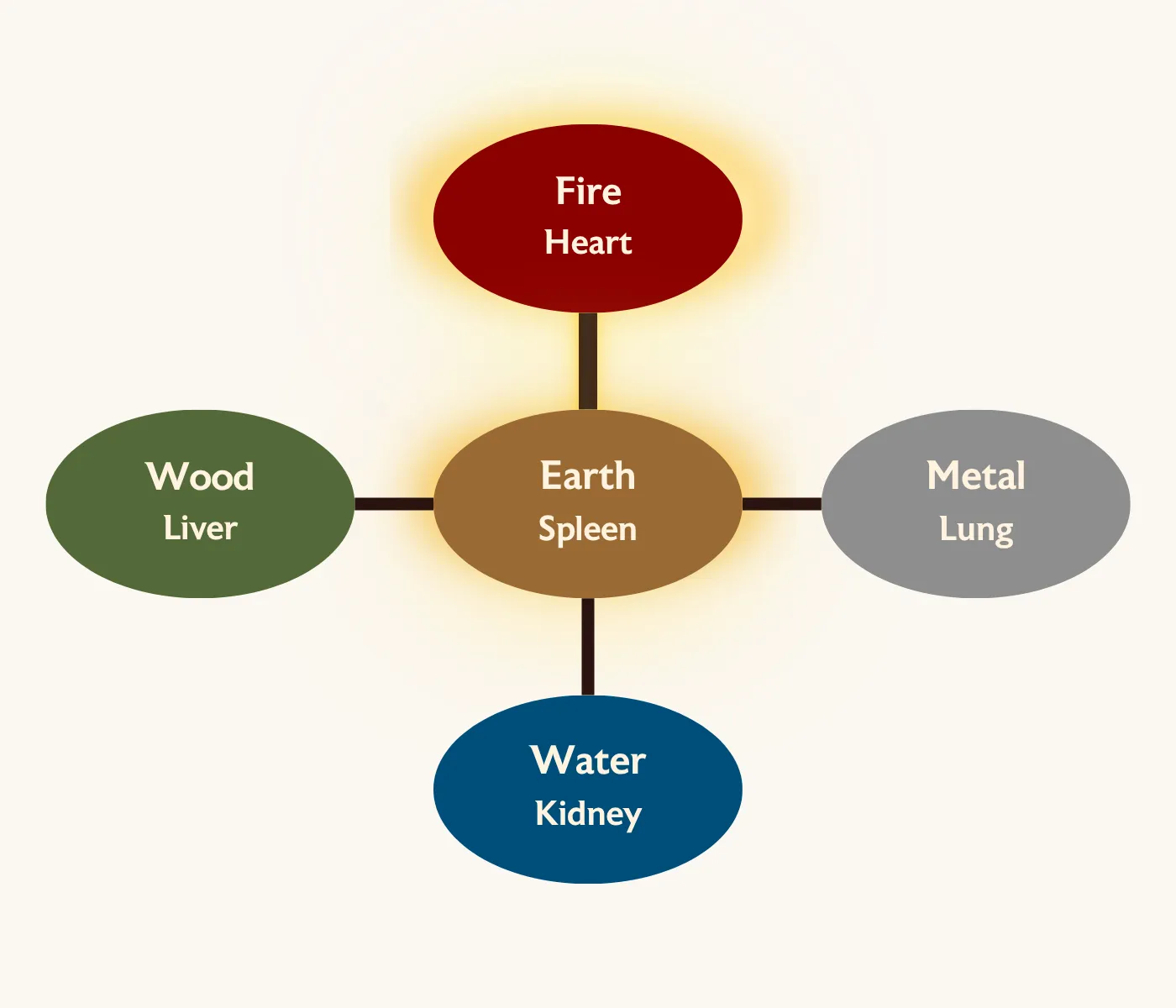
Last time around, in my explanation of the Hearth Principle, I explained how CV takes those Five Phases and orients them around the Earth-to-Fire axis (which we can also call the Spleen-to-Heart axis), because of our deep emphasis on bodily purpose. By “purpose,” we’re not talking about unbounded productivity or external achievement (obsession with these things is indeed often a result of a dysregulated overdriven approach to energy), but rather about a well-ordered presence in the world, calm but capable of necessary action. To review, this means our image of the Five Phases isn’t an ongoing circular cycle, but rather, something like this.
From my Orthodox Christian perspective, I like to think of it as a cruciform pattern:
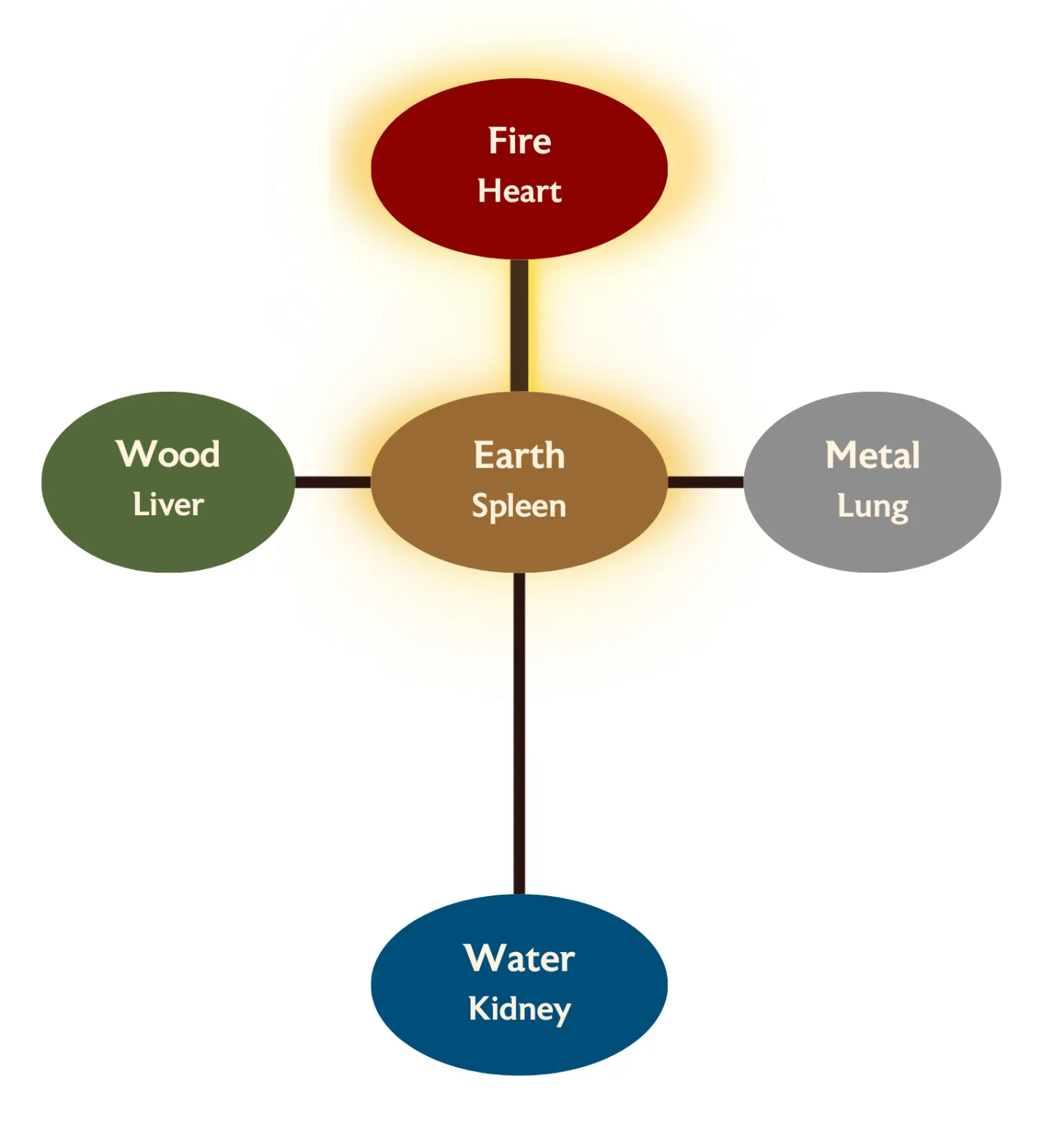
In my Hearth Principle post, I ended with my observation that Earth/Fire symbolism is remarkably resonant with Orthodoxy, comparing Orthodoxy’s teaching that salvation is about theosis with the CV principle that health is centered upon steady Hearth-like energy. Again, to assuage potential concerns from Orthodox and secular readers alike, I’m not making a grandiose metaphysical claim conflating Orthodox Christianity with a TCM or CV view of health. But from a CV perspective, it’s delightful how smoothly the TCM Five Phases can be read in this cruciform fashion.
In this image of the Cruciform Five Phases (CFP), we have Earth (the Spleen/Stomach axis) as the bodily center, responsible for consolidation and distribution, Water (Kidneys) as the depths wherein our deepest life reserves are stored, and the Fire of the Heart as the summit. Meanwhile, Metal (Lungs) and Wood (Liver) naturally play the role of the lateral arms of this cruciform image of the body, because both deal heavily with our outward relationship with the world. Metal governs boundaries and exchange (what comes in and out), while Wood concerns initiation and directed movement. Overall, an intuitive and clinically useful approach to the Five Phases, even if spiritual orientation is bracketed.
My intro post to this blog discussed how both liturgical cycles and seasonal cycles are key aspects of living in healthy rhythm. Here, I want to explore that further, by using the language of the Five Phases to begin a series of reflections I plan to do over the next year, on the cycle of the Great Feasts of the Church.
Today, one week after the Church New Year, we have the first of those 12 Great Feasts, the greatest celebrations of the yearly cycle. In the midst of these celebrations is the one that transcends even the glory of those 12 Feasts. Pascha (Easter, to use the Western term) is in a category unto itself, the Feasts of Feasts that opens this cycle into a revelation of the unending day of God’s eternal kingdom. As mentioned in that intro post, CV takes special note of how our human bodily organisms similarly rely on rhythmic participation in cycles, but our bodily cycles aren’t just repetition for their own sake. Rather, just like the liturgical year, they are directed toward an ultimate purpose.
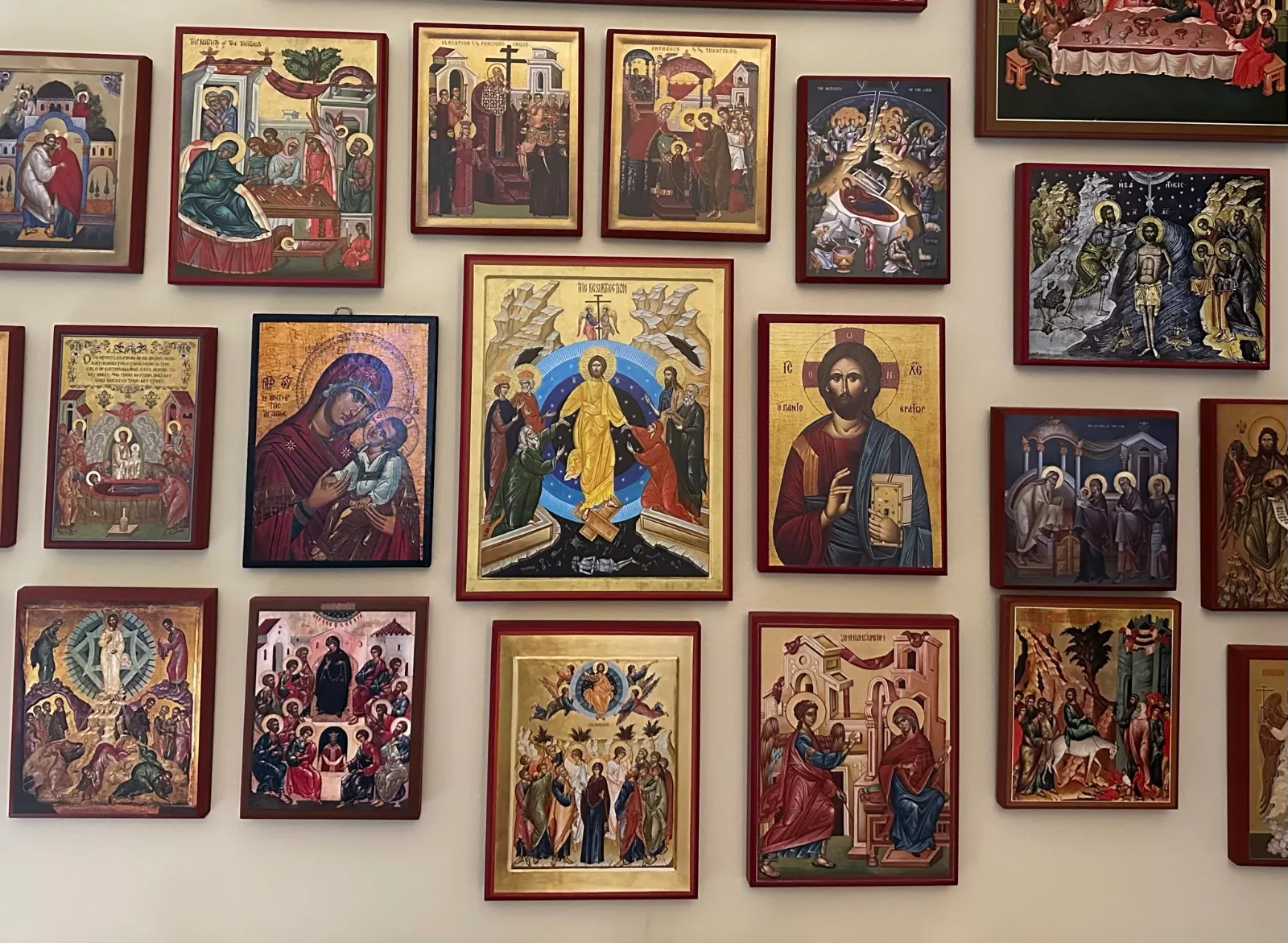
In the body (as we’ve discussed), the relationship between Earth (that which receives and houses) and Fire (that which orders meaning and radiates purpose) is central, surrounded by the complex yet coherent ebbs and flows of the other Phases. If we run with the spiritual symbolism evident within the Hearth Principle, a Five Phases reading of the liturgical cycle looks remarkably similar.
The Nativity of Christ is very much a feast resonant with the Phase called Earth (associated with the Spleen/Stomach), being centered on the specific Incarnate fleshly birth of Christ. More specifically, we can say it’s a feast of Earth receiving Fire: in this case, the unimaginable fire of Christ’s eternal divinity contained within a body. The Phase of Fire (associated with the Heart) is of course analogous to the Paschal Feast of Feasts, marked by its radiant and pure ultimate meaning. More specifically, we can say it’s a feast of Fire transfiguring Earth, with the victorious resurrection of Christ remaking the created vessels of the body, the world, the cosmos, and history, allowing the earthly to enter eternal divine reality. So, in the dynamic between perhaps the most foundational of the 12 Feasts and the even greater Feasts of Feasts, we see the same Earth-to-Fire centrality. The Earth of Nativity points upward to the Fire of Pascha, like the Spleen receiving and transforming what the Heart then circulates and radiates outward.
I’ve observed that the other Feasts are similarly easily interpreted in this schema of one primary Phase in relation to another. The “one in relation to another” convention is natural, given that the Five Phases, unlike the Western Four Elements, are intrinsically relational. You can’t really think about what one does without thinking about its place in a practical cycle. After noting that such symbolism fits the Feasts well, I intuitively began to consider how the bodily cycle of the Five Phases (the way in which these organs/systems dynamically and rhythmically interact within the human organism) might help me reflect further on the experience of the cycle of feasts.
Orthodoxy emphasizes the embodied action of prayerfully worshipping in these liturgical events. Our mental thoughts about the feasts are not nearly as important as standing in church and having our full selves transformed by the immersive experience of the commemoration; seeing the icons, physically venerating them, smelling the incense, hearing the chanted Psalms and beautiful singing of ancient hymns, and tasting the Eucharist itself. So, given the 1) deeply embodied nature of Orthodox worship and 2) CV principle of health as not the absence of suffering but rather a graceful relationship with time and space, I’ve thought about how the Phase-resonances of the feasts might subtly include medicine for “the healing of soul and body.”
Again, there’s nothing I can say about the feasts that hasn’t been said infinitely better by the saints of the Church. These are the simple private reflections of a wellness educator. If you want to learn the Patristic interpretations of the feasts, I strongly recommend The Feasts of the Lord and The Feasts of the Mother of God, by Metropolitan Hierotheos.
To get to today’s commemoration, the festal cycle starts at the very beginning. Several months and feasts before the Nativity of Christ in the winter, we begin with the Nativity of the Theotokos, the Virgin Mary. St. Nikolai Velimirovic (among the greatest Orthodox writers of the 20th century) described the cycle of these feasts as a sacred book that begins with the words “In the Jewish town of Nazareth lived the childless elder Joachim and his wife Anna…” And indeed, today the Church celebrates the birth of the Theotokos, God’s answer to the prayers of the formerly barren Saints Joachim and Anna, the Holy and Righteous Ancestors of God.
For those who don’t know about the feast and wish to learn more, I’ll link here to two different wonderful spiritual writings on the topic.
I read today’s commemoration as a feast of Earth preparing Water. Earth is the Phase with foremost relevance here because it correlates to substance and inhabitability, to the tangible and embodied qualities of vessels (think of the Spleen/Stomach axis at the center of the body receiving input, containing/holding it, and transforming it into useable nourishment). In this feast, the divine plan unfolds in terms of unmistakably concrete realities. A particular barren womb is made fruitful. The Theotokos is born into a specific lineage and household. The vessel of Christ Himself is quietly prepared.
The secondary Phase here is Water because this is a day filled with joy but in a different way than some later feasts. It’s not the actual birth of Christ Himself as we get in Nativity, or even the full proclamation and acceptance of the Incarnation that we hear in the Annunciation, and we’re certainly a long way off from Pascha and Pentecost. Heaven and earth rejoice with Saints Joachim and Anna but we’re celebrating a beginning that awaits greater fulfillment.
Water relates to reserves, depths, hiddenness, and potential. In TCM and CV, through governing the body’s fluids and preserving underlying balance, the Kidney/Bladder axis acts as a storehouse of deep concealed capacity. The reservoir of bodily Water relates to basic capacity for life passed on from generation to generation. So, there’s strong relevance to the formerly barren womb of St. Anna, the old age of these saints, and the emphasis on the Theotokos’ lineages (St. Joachim being of the royal tribe of Righteous King David, St. Anna being of the priestly tribe of the Righteous Aaron).
Here, Water seems to be in collapse but is held by Earth. Lineages contain a hidden promise. A household prayerfully holds the reality of barrenness. A womb generates life despite seeming like no reserves were left.
Second to the central spiritual medicine this feast’s many beauties, the way these Phases symbolically interact here can also be medicinal for different kinds of bodily imbalances.
Unbalanced Earth in the body can lead to heaviness, sluggishness, and stagnation, especially when we overly depend on comfort. This feast reminds us that households and bodies don’t exist for their own sake: rather, they are meant to be prepared as vessels for that which is even more important than them.
When bodily Water collapses, we can fearfully feel like we have no meaning or endurance left. This feast reminds us that reserve depletion is not final: God may yet bring hidden capacity to fruitfulness.
When Wood (the system of initiating, growth, and movement associated with the Liver) gets agitated, we can become restless, tense, and irritable. Later in the year, Annunciation is a truer “Wood” moment, in the healthiest sense, while this feast is a quiet beginning. The Theotokos must first be born and raised before she can give her history-defining “yes” to God, reminding us that subtle preparation is needed before dramatic advance.
When Metal (the body’s sorting /filtering function associated with the Lungs and Large Intestine) becomes excessive, healthy boundaries can harden into constriction, dryness, and rigidity. Here, we see an attention to form (Saints Joachim and Anna’s vow to dedicate the child given to them to the service of God in the temple) playing its proper role. Namely, providing the boundaries necessary for a precious vessel to fulfill its purpose.
When Fire becomes scattered and excessive, our bodies can overheat, feel overstimulated, and spend energy faster than we can replenish. The feast is ultimately all about the eventual coming of Christ (“the Sun of Righteousness,” to use a title of His derived from the book of Malachi) into history and the world. But, before that peak, the Church commemorates the birth of the vessel that contained Him. The feast can help us remember that before our bodies can healthily glow with Fire’s energy, we must prepare the space that can contain it.
Alright, this has been an Ortho-heavy post and there will be a similar one coming up this Sunday, as we’re blessed to have the second Great Feast of the Church year coming up quite soon, the Universal Exaltation of the Precious and Life-giving Cross. And after that I’ll be back with a post on the most important practical difference between Constitutional Vitalism and other approaches to healing. I hope you’ve enjoyed this reflection on the Five Phases and to my Orthodox readers, happy feast day!
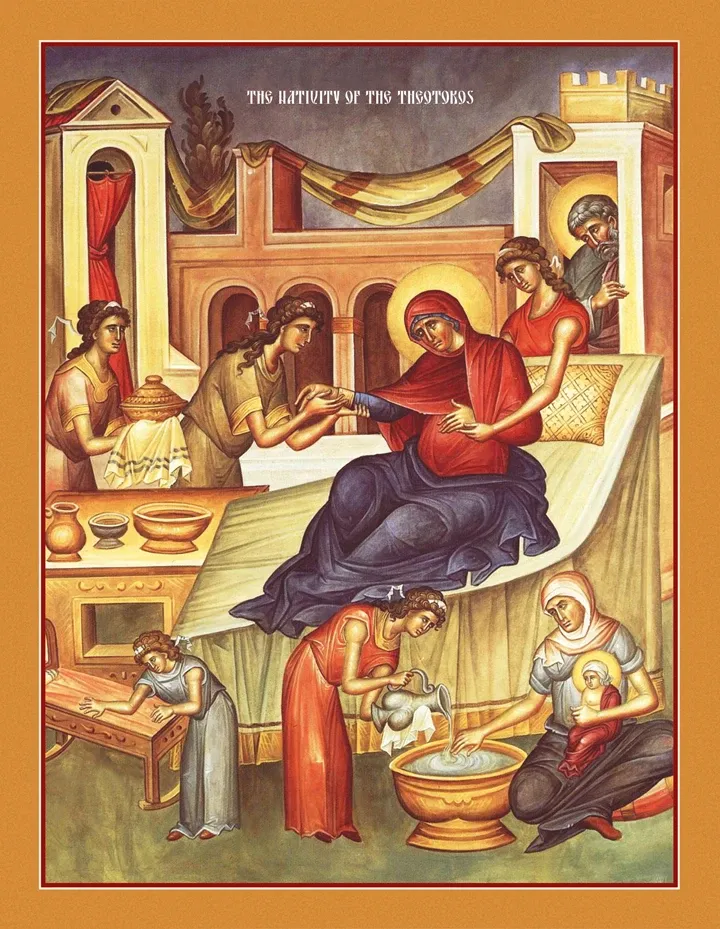
Tropar of the Feast, tone 4: Thy nativity, O Theotokos Virgin, hath proclaimed Joy to all the world; for from thee hath dawned the Sun of Righteousness, Christ our God, annulling the curse, and bestowing the blessing, abolishing death and granting us life eternal.